
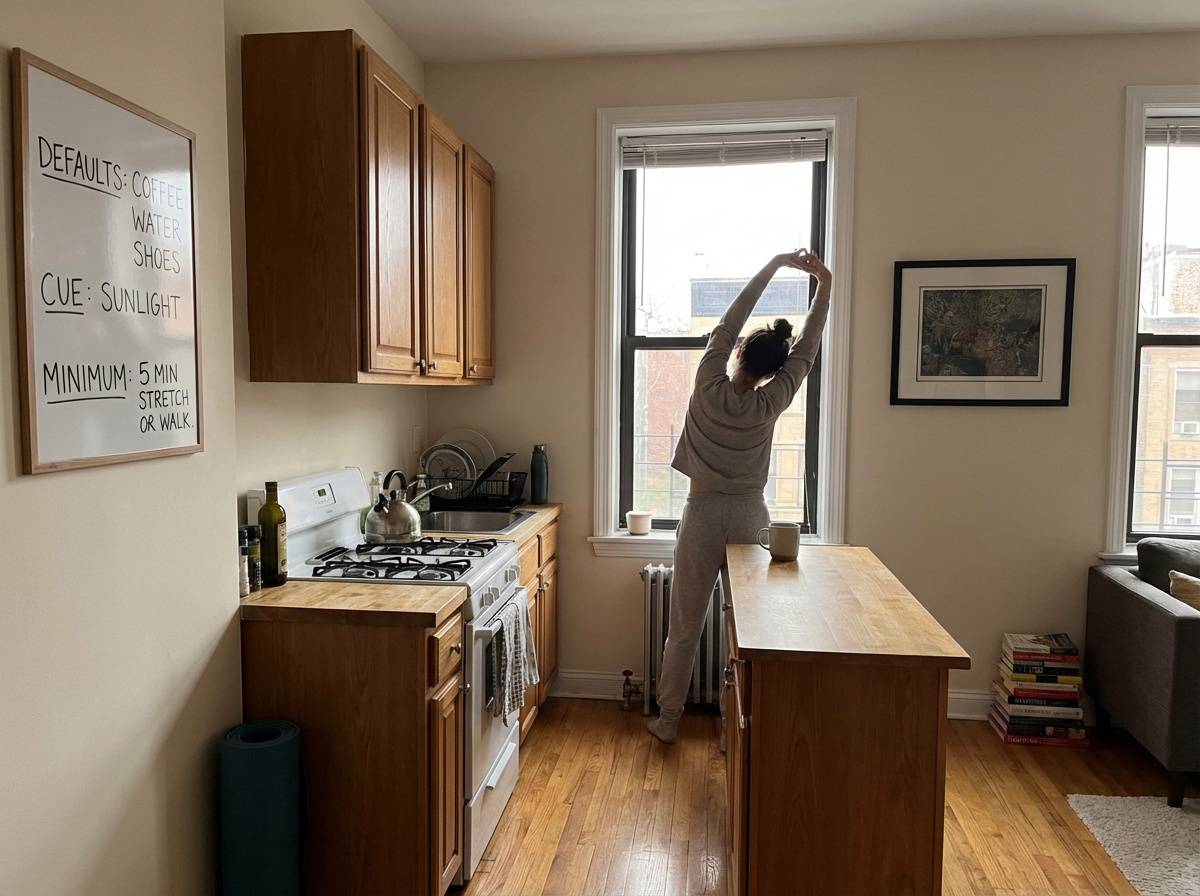
Why Most Morning Routines Fail (Even If They Look Perfect Online)
Most morning routines don’t fail because the person “lacks willpower.” They fail because the routine was built for a fantasy life: a quiet house, unlimited time, stable energy, and zero stress. Real life doesn’t run that way.
LifestyleSelf morning routines are designed for reality: unpredictable nights, busy mornings, changing work demands, family obligations, travel, and the occasional week where you’re simply not operating at your best.
A morning routine fails when it has only one setting: the “perfect” version. When that version becomes impossible, the routine collapses—and suddenly you’re starting over again.
The goal of a LifestyleSelf routine is not to create an impressive morning. It’s to create a reliable start: a system that protects energy, reduces decision fatigue, and keeps you aligned with your life style self.
The LifestyleSelf Morning Rules (The System Behind the Routine)
Before we build the routine itself, we need the rules. These rules stop you from overcomplicating, overcommitting, and burning out.
Rule 1: Morning routines are for identity, energy, and momentum
A strong morning routine supports the identity you chose in Part 2. It helps you collect proof early—before life starts pulling on you. That proof matters because it changes the emotional tone of the day. You’re no longer “hoping” you’ll be disciplined later. You’ve already practiced it.
Rule 2: Protect the first decision (because it controls the next five)
Morning chaos is usually not one big mistake—it’s a chain reaction of small, unplanned choices. A LifestyleSelf routine protects the first decision: the moment you wake up. If you win the first decision, the next ones become easier.
Rule 3: A routine is not a checklist—it's a sequence
People often cram 10 activities into the morning. It becomes stressful and fragile. LifestyleSelf routines are sequences: a few steps in the right order that produce calm, energy, and action.
Rule 4: Your routine must have settings (Minimum / Standard / Stretch)
This is the LifestyleSelf habit ladder applied to mornings. You will use different settings depending on the day. The goal is not to force the standard every day. The goal is to stay aligned every day.
Rule 5: If you want better mornings, build better nights
Morning routines often fail at night. Sleep quality, late-night screens, and “one more thing” work sessions are morning routine killers. You don’t need a heroic morning if you engineer a calmer night.
The 3-Level Routine Ladder (Minimum, Standard, Stretch)
Most people treat mornings like a pass/fail test. Either they do the full routine or they “failed.” LifestyleSelf removes that trap. You build three versions of your morning routine:
The routine that keeps your identity alive when you’re late, tired, or stressed. Minimum is continuity. Minimum counts.
Your normal routine on most days—built for momentum and energy without overloading your schedule.
Optional. Only when life supports it. Stretch is a bonus—not a requirement.
You stop “starting over.” You simply choose the correct setting and stay aligned.
What a “minimum morning” can look like
- Drink water + 2 minutes of breath work
- Quick wash + clothing decision already made
- 5–8 minutes of mobility or a brisk walk outside
- One simple plan: “Today’s top 1 priority is ____.”
What a “standard morning” can look like
- Hydration + light exposure
- Movement block (walk, mobility, or training)
- Protein-forward breakfast or set meal plan
- One focused work block or day planning

How to Build Your Routine (The LifestyleSelf Morning Routine Framework)
We’re going to build a routine using the “4 Anchors” framework. These anchors cover what most people actually need in the morning, without turning the morning into a complicated ceremony.
The 4 Anchors
- Wake Anchor: how you transition from sleep to action (without chaos)
- Body Anchor: movement, mobility, or training to stabilize energy and stress
- Fuel Anchor: hydration + nutrition decision (reduce later cravings and fatigue)
- Direction Anchor: focus plan (what matters today, what doesn’t)
Step 1: Choose your “identity anchor” (from Part 2)
Your routine should support your primary identity. If your identity is “I protect my sleep,” the routine should not be aggressive and chaotic. It should reward consistency. If your identity is “I move daily,” you need a movement anchor that’s easy to start.
Step 2: Choose your minimum routine first
Most people start by designing the perfect routine. LifestyleSelf starts with the minimum. Minimum is the part you can keep when life is hard. Once minimum exists, everything else becomes easier.
Step 3: Build the standard routine around your schedule reality
Your routine must fit your actual start time and responsibilities. If your day begins at 7:30AM, building a 90-minute morning routine is not ambitious—it’s unrealistic. LifestyleSelf routines respect real calendars.
Step 4: Add one optional stretch layer
Stretch is where you add extras: journaling, longer workouts, deeper planning, reading, meditation, or creative time. Stretch is never the requirement. Stretch is the reward.
Busy-Day Defaults (No Negotiation Required)
Busy days are where most routines break. LifestyleSelf uses defaults so you don’t waste energy deciding. A default is not a “perfect plan.” It’s the plan you run when you don’t have time to plan.
Default 1: The “Late Start” minimum
- Water (immediate)
- 2 minutes breath + posture reset
- 5 minutes mobility or walk outside
- One sentence plan: “My top 1 today is ____.”
Default 2: The “Chaos Week” baseline
- Minimum movement daily
- One anchored meal decision (protein + fiber)
- One focus block (25–45 minutes) OR one “finish” task
- Simple wind-down at night (so tomorrow isn’t worse)
Default 3: The “Travel Morning”
- Hydration + light exposure
- 10–20 minute walk
- Simple breakfast choice (avoid “random” choices)
- Short planning: 3 priorities, 1 boundary
Triggers, Friction, and Your “Start Ritual”
The hardest part of a routine is starting. Starting is a friction problem. LifestyleSelf routines are designed with clear triggers and reduced friction.
Create a “start ritual” (30–90 seconds)
The start ritual is the smallest action that signals: we’re beginning. It should be ridiculously simple, repeatable, and consistent.
- Drink water from a bottle placed beside the bed
- Open blinds / step into light
- Wash face + get dressed (clothes set out)
- Start a specific playlist
- Write today’s top 1 on a sticky note
Remove friction (the night before)
If your morning depends on thinking, it will fail under stress. Reduce thinking. Reduce steps.
- Set clothes out
- Put water where you’ll see it
- Prep breakfast ingredients
- Put phone on a charger away from the bed
- Write tomorrow’s top 1 on paper
Add friction to distractions
- Notifications off until after your first anchor
- Social apps moved off home screen
- Phone stays in another room until after movement
5 LifestyleSelf Morning Routine Templates (Choose What Fits)
These templates are designed for different schedules and personalities. The goal isn’t to copy them perfectly. The goal is to pick one and customize the anchors.
Template 1: The 12-Minute Minimum (for chaos mornings)
- Wake anchor: water + blinds open (1 minute)
- Body anchor: mobility or brisk walk (7 minutes)
- Direction anchor: “Top 1 + Top 3” list (4 minutes)
Template 2: The 30-Minute Standard (balanced)
- Water + light exposure (3 minutes)
- Movement (walk, mobility, light training) (15 minutes)
- Protein-forward breakfast decision (7 minutes)
- Day direction: 1 priority + 1 boundary (5 minutes)
Template 3: The Focus-First Morning (for creators/knowledge work)
- Start ritual + water (2 minutes)
- 25-minute focus block (no notifications)
- Movement break (8–12 minutes)
- Fuel anchor (simple breakfast / coffee after focus)
Template 4: The Training Morning (fitness-first identity)
- Wake anchor + hydration (3 minutes)
- Warm-up + training (20–45 minutes)
- Protein anchor meal (10 minutes)
- Direction anchor (5 minutes)
Template 5: The Calm Morning (stress regulation / nervous system)
- Breath work or quiet sit (5 minutes)
- Walk outside (10–20 minutes)
- Simple breakfast + hydration
- Gentle planning: 3 priorities, 1 “no”
Common Morning Routine Mistakes (And the LifestyleSelf Fix)
Mistake 1: Making the routine too long
Long routines fail because life interrupts. Fix: build a strong minimum routine and keep the standard realistic.
Mistake 2: Trying to do everything every morning
Journaling + meditation + workout + reading + planning + perfect breakfast becomes pressure. Fix: choose 2–4 anchors and rotate stretch items when life supports it.
Mistake 3: Starting with your phone
Starting with your phone starts your day in reaction mode. Fix: delay the phone until after your first anchor (movement or focus).
Mistake 4: Ignoring nights
Late nights create tired mornings. Fix: build a wind-down cue and prep the first step. Part 5 will go deeper into sleep and energy: Sleep & Energy Reset.
Mistake 5: Thinking a missed day means failure
Fix: use the minimum routine tomorrow and return cleanly. This connects directly to Part 4’s discipline model.
FAQs
How early do I need to wake up for a LifestyleSelf morning routine?
You don’t need a dramatic wake-up time. You need a routine that fits your life. Minimum can be 8–12 minutes. Standard can be 20–45. The goal is consistency, not an early-morning identity performance.
What if my mornings are unpredictable because of kids or work?
Perfect—build a strong minimum routine and a “busy-day default.” If your schedule is unpredictable, your routine must be flexible by design.
Should I work out in the morning or later?
Choose what you can sustain. If mornings support consistency, train in the morning. If mornings are chaotic, use minimum movement in the morning and schedule training later.
What’s the best first step when I wake up?
LifestyleSelf recommends a simple start ritual: hydration + light exposure, or hydration + a quick breath reset. Keep it easy so you actually do it.
How do I stop grabbing my phone first thing?
Add friction: charge it outside the bedroom, turn off notifications overnight, and create a default first action (water beside the bed). Make the first right action easier than the first wrong action.
Do I need journaling and meditation?
Only if they support you. LifestyleSelf routines are built around anchors. Stretch items like journaling can be added when life supports it, but they are never required for the routine to count.
What if I miss a morning routine day?
Use the minimum routine tomorrow. Don’t punish. Don’t restart. Returning quickly is the skill. Part 4 teaches the full reset model.
How long until this becomes automatic?
Many people feel calmer within a week when they remove friction and use defaults. “Automatic” typically arrives after consistent repetition and simple tracking over a few weeks.
Next Up: Discipline Without Burnout
Morning routines create momentum. But momentum has to survive stress, travel, low-energy days, and hard weeks. In Part 4, you’ll build LifestyleSelf discipline: baseline habits, clean resets, and recovery-aware consistency that holds without self-punishment.